After the assassination of the shogun’s regent, Ii Naosuke, in the Third Month of the Japanese year corresponding to 1860, the revolution was led by samurai of Satsuma, Choshu, and Tosa. Around this time in Tosa emerged two men who would inform the revolution—both charismatic swordsmen originally from the lower rungs of Tosa society.
Takechi Hanpeita was a planner of assassinations and stoic adherent of Imperial Loyalism and bushido, whose political agenda led to his downfall and eventual death. Sakamoto Ryoma, one of the most farsighted men of his time, had the guts to throw off the old and embrace the new as few men ever have—and for his courage, both moral and physical, he was assassinated on the eve of a revolution of his own design. And while Hanpeita and Ryoma were close friends, they had contrasting personalities, as indicated in the following anecdote taken from my Samurai Tales:
[begin excerpt] Known for their ability to consume vast amounts of sake at a single sitting, the young men of Tosa were wont to drink a potent local brew as a condiment to political discourse. One day, upon leaving a political meeting at Hanpeita’s home, Ryoma, as was his habit, relieved himself in his friend’s front garden, so that after he had left the stench of stale urine remained. When Hanpeita’s wife complained about Ryoma’s “sickening habit,” he turned to her and sternly said, “Ryoma is a man of consequence to the nation. I think you can tolerate that much from him.” [end excerpt]
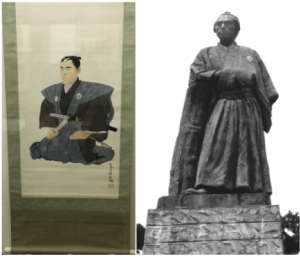
[The above portrait of Takechi Hanpeita is on exhibit at the Sakamoto Ryoma Memorial Museum in Kochi. The statue of Ryoma is at Katsurahama in Kochi.]
Read more about the lives of both men in Samurai Tales and my historical novel, Ryoma: Life of a Renaissance Samurai.